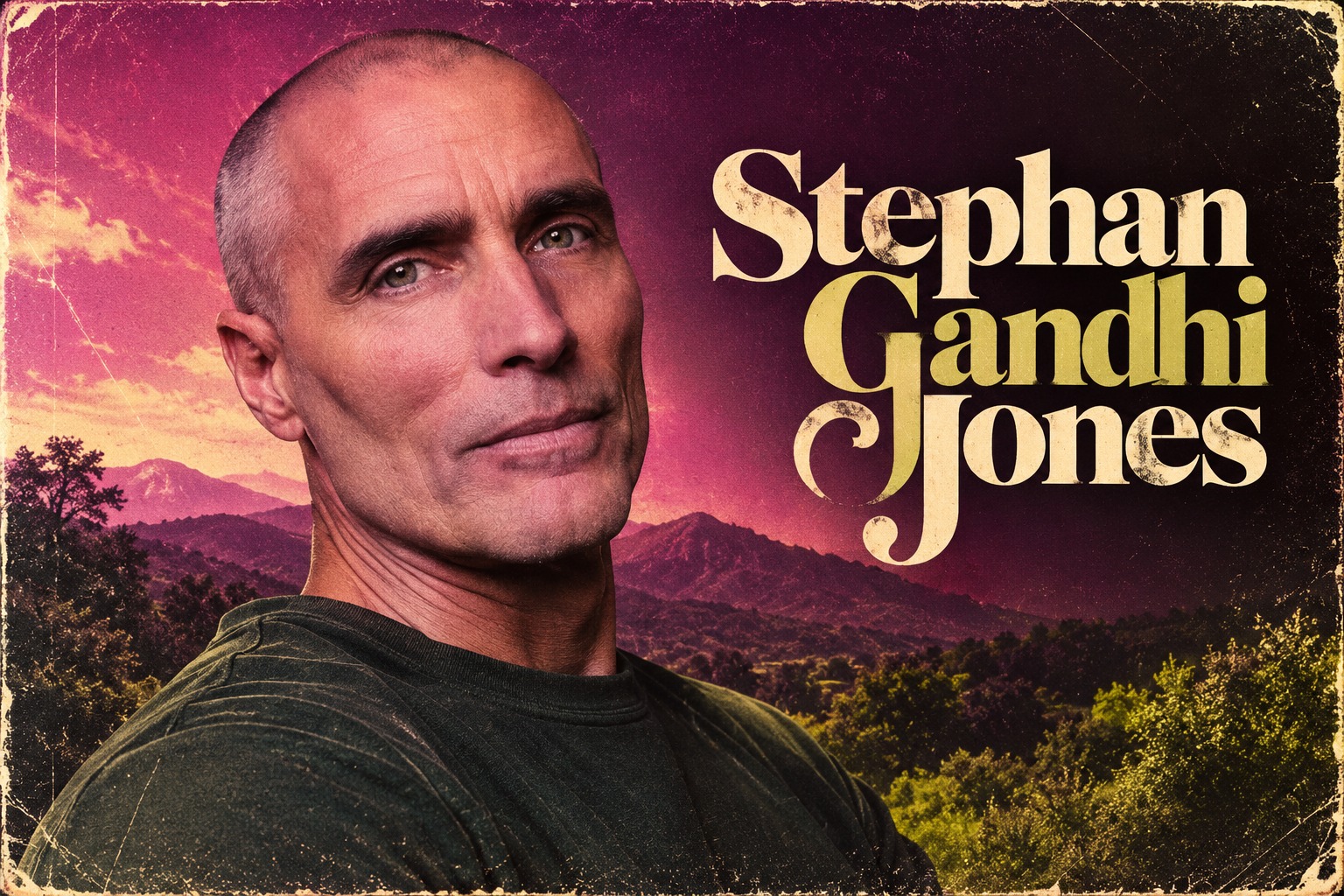
A son whose story continued
Stephan Gandhi Jones was born on June 1, 1959, in Indianapolis, Indiana. He was the only biological son of Jim and Marceline Jones, within a family that also included adopted children from several backgrounds. He survived the events at Jonestown on November 18, 1978, because he was in Georgetown with the Peoples Temple basketball team. I approach his life as a survivor’s biography, rather than as an extension of his father’s leadership.
That distinction is essential. Jim Jones directed Peoples Temple and became responsible for the catastrophic final events in Guyana. Stephan was a young member of the community and a son who later had to reconstruct his life after losing parents, siblings, and the environment in which he had grown up.
Jim Marceline and the family household
Jim Jones was born in 1931, and Marceline in 1927. Both died at Jonestown in 1978. Their household was associated with the Temple’s early emphasis on racial integration and the idea of a family formed across racial and national backgrounds.
Stephan’s siblings included Jim W. Jones Jr., Lew Eric Jones, Suzanne Jones, Agnes Pauline Jones, Timothy Glen Jones, and Stephanie Jones. They were adopted members of the family, while Stephan was the biological child. I retain that distinction to clarify the family structure, not to assign a different value to any sibling relationship.
Stephanie died in a car accident in 1959, before Stephan’s birth. Lew Eric and Agnes died at Jonestown. Jim Jr., Suzanne, and Timothy survived through different circumstances. The family account is therefore marked by losses occurring at different times, not only by one day in November 1978.
Childhood in Indiana and California
The Temple moved from Indiana to California in 1965, bringing Stephan into a new geographical setting during childhood. Redwood Valley became part of his early life, alongside the community’s social and religious activities.
Sport, especially basketball, was important to him. The interest later became a direct factor in the circumstances of his survival, but it began as part of his life within the community.
His paternal grandparents were James Thurman Jones and Lynetta Putnam. Their place in the older family generation helps separate Stephan’s ancestry from the later Temple household. The public history is complicated enough without treating all Jones relatives as if they occupied the same role in the organization.
The move to Jonestown
At 17, Stephan went to Jonestown, the Temple’s agricultural settlement in Guyana, in December 1976. He worked on construction and other practical tasks as the community expanded rapidly.
He initially found purpose in physical labor and in helping build the settlement. Later, he witnessed mounting tensions and opposed aspects of his father’s plans. Those changes matter because they resist a simplified portrait of unbroken loyalty or an immediate, complete rejection of the community.
I see his experience as one of growing distance within a setting he still knew intimately. The settlement contained work, relationships, and hopes alongside the escalating control that preceded its destruction. Describing those ordinary elements does not excuse the leadership that brought the community to catastrophe.
Georgetown on November 18 1978
Stephan was 19 when the basketball team’s trip placed him in Georgetown rather than Jonestown. More than 900 people died in the catastrophe, including many members of his family. His absence made survival possible while leaving him connected to the events through messages, uncertainty, and the later realization of their scale.
He spent about three months in a Guyanese jail after the deaths. He later described that period as part of his transition back toward ordinary life. The detention belongs to the aftermath and should not be confused with evidence that he directed what happened at Jonestown.
I do not convert his later regret into a claim that he could certainly have prevented the deaths. Survivors can question their absence or imagine alternatives without those thoughts establishing what would have happened. His reflections describe the burden of surviving, not a proven alternate history.
Work marriage and fatherhood
After returning to the San Francisco area, Stephan rebuilt his life through work, relationships, and sport. His occupation became office furniture installation, a practical field quite separate from public religious leadership or entertainment.
He married Kristi Jones in 1991, and they have three daughters. Fatherhood became an important part of his later life. I regard that family chapter as central rather than an afterthought appended to a survivor story.
The daughters belong to a new generation. Their grandfather’s notoriety is part of their ancestry, but it does not define their own lives. Stephan’s work and household demonstrate that his adult biography continued beyond the events that first brought his name to public attention.
Speaking and preserving the history
Stephan has contributed essays, identified photographs, spoken publicly, and participated in documentaries about Peoples Temple and Jonestown. His activities have included a 2013 appearance at Bucknell University’s Griot Institute and participation in the 2024 documentary Cult Massacre: One Day in Jonestown.
These contributions provide a survivor’s perspective on the community’s attraction, its deterioration, and the people who died. I find that perspective valuable because it can address more than the final spectacle. It also asks how a movement associated with social ideals became a setting for manipulation and destruction.
His public reflections have included forgiveness and the complexity of remembering his father. Such reflections are personal responses, not a reversal of the historical responsibility attached to Jim Jones. They form part of Stephan’s effort to live with a family history that remains unusually difficult.
FAQ
Why did Stephan survive Jonestown?
He was in Georgetown with the Peoples Temple basketball team on November 18, 1978. His absence from Jonestown placed him outside the settlement when the mass deaths occurred, although he lost parents, siblings, and many people he knew.
Who are his parents and surviving siblings?
His parents were Jim and Marceline Jones. Among the siblings identified in the family account, Jim W. Jones Jr., Suzanne Jones, and Timothy Glen Jones survived. Lew Eric and Agnes died at Jonestown, while Stephanie had died in 1959.
What has he done since returning to the United States?
He has worked in office furniture installation, married Kristi, and raised three daughters. He has also contributed writing, interviews, talks, and documentary participation to the public understanding of Peoples Temple and Jonestown.